How to Learn Artificial Intelligence for Beginners: A Step-by-Step Guide

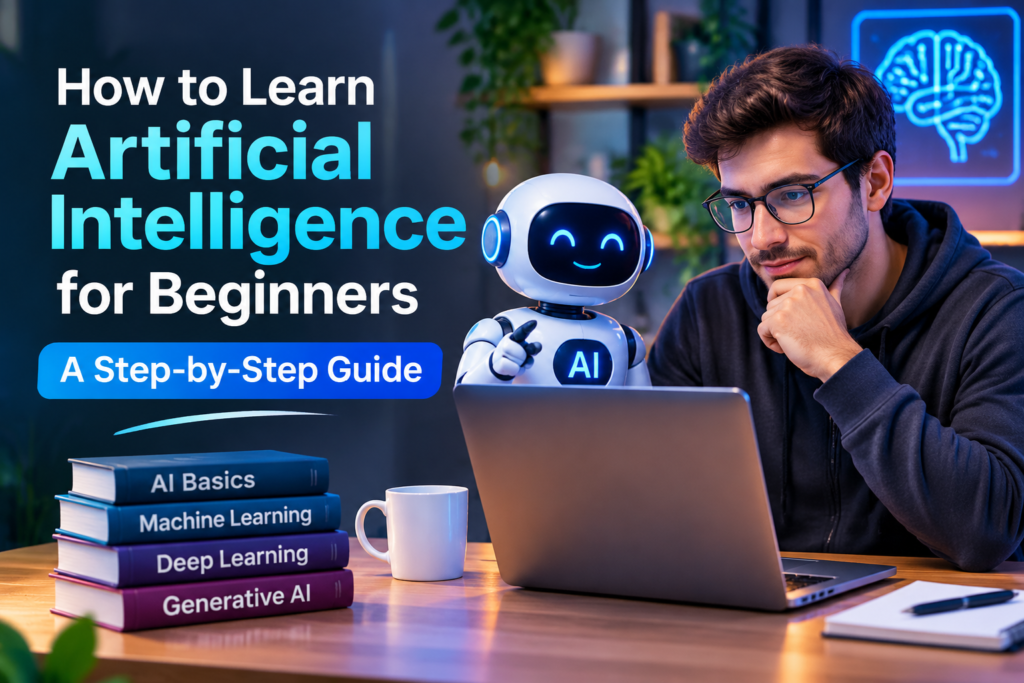
Table of Contents
Artificial intelligence is changing the way people work, learn, communicate, and solve everyday problems. From writing assistants and chatbots to image generators and smart business applications, AI has become an important part of modern technology. However, for someone completely new to this field, understanding where to begin can feel confusing.
If you are looking for how to learn artificial intelligence for beginners, starting with basic concepts, exploring AI tools, and practising with simple projects can help you build a strong foundation.
The good news is that learning artificial intelligence does not require an advanced technical background. Beginners can start by exploring simple AI tools, understanding basic concepts, and practising with real-world examples. Those interested in developing AI systems can gradually move towards programming, mathematics, and machine learning.
If you are wondering how to learn artificial intelligence for beginners, this guide will help you understand the essential concepts, explore useful learning resources, and follow a practical roadmap to develop your skills.
What Is Artificial Intelligence?
Artificial intelligence (AI) is a branch of computer science that focuses on creating systems capable of performing tasks that normally require human intelligence. These tasks include understanding language, recognising images, analysing information, identifying patterns, and generating new content.
AI systems use different technologies and techniques to process information and produce results. To understand the broader impact of this technology, explore how artificial intelligence is changing the way we live and work in 2026. Some applications follow predefined instructions, while others learn patterns from large amounts of data.
You may already interact with artificial intelligence through everyday applications, including:
- AI chatbots: Answer questions, explain concepts, and assist with writing.
- Recommendation systems: Suggest videos, products, and music based on user interests.
- Voice assistants: Understand spoken commands and respond to requests.
- Image generators: Create pictures and illustrations from written descriptions.
- Translation tools: Convert text from one language into another.
- Productivity applications: Help organise information, summarise documents, and automate tasks.
Understanding these examples is a useful starting point when learning artificial intelligence for beginners.
How to Learn Artificial Intelligence for Beginners: 7 Practical Steps
Starting with a structured learning approach makes AI easier to understand. Instead of trying to learn everything simultaneously, focus on one skill at a time and gradually increase the complexity of your learning activities.
Step 1: Understand the Fundamentals of AI
Begin by learning what artificial intelligence means and how it works. You do not need to understand complicated algorithms immediately. Focus on developing a clear understanding of the basic terminology and applications.
Understanding artificial intelligence for beginners becomes easier when you start with simple concepts and explore how AI is used in everyday applications.
Start with these important concepts:
- Artificial intelligence and its applications.
- Machine learning and how computers learn from data.
- Deep learning and neural networks.
- Generative AI and content creation.
- Natural language processing and computer vision.
Understanding these concepts will help you recognise the differences between various AI technologies and how they are used in real-world situations.
Step 2: Explore AI Tools and Practise Daily
One of the easiest ways to understand artificial intelligence is by using AI-powered applications. Practical experience allows beginners to see how these systems respond to instructions and process information.
Some popular tools to explore include:
- ChatGPT: Useful for explanations, brainstorming, writing, and research assistance.
- Google Gemini: Helps with questions, information analysis, and creative tasks.
- Claude: Useful for writing, analysing documents, and understanding complex information.
- Microsoft Copilot: Assists with productivity and everyday digital tasks.
Try using these tools for different activities. Ask questions, request explanations, summarise information, and compare their responses.
Regular practice will help you understand how AI tools work, where they are useful, and why their results should always be checked for accuracy.
Step 3: Learn Prompt Engineering
Prompt engineering involves writing clear instructions that help AI tools produce useful and relevant responses.
A good prompt usually explains the task, provides relevant context, and describes the expected result.
For example, instead of writing:
“Explain artificial intelligence.”
Try a more specific instruction:
“Explain artificial intelligence to a complete beginner using simple language, practical examples, and a short explanation of how machine learning works.”
Practise creating prompts for different tasks, including writing, research, planning, summarisation, and problem-solving.
Learning how to communicate effectively with AI is an important skill for beginners, particularly those who want to use AI tools without learning programming.
Step 4: Learn Basic Programming with Python
If your goal is to develop AI applications or build intelligent systems, learning programming is an important next step.
Python is one of the most popular programming languages used in artificial intelligence because it has a relatively simple syntax and a large collection of useful libraries.
Start by understanding:
- Variables and data types.
- Conditional statements.
- Loops and functions.
- Lists and dictionaries.
- Basic data manipulation.
After understanding these fundamentals, explore Python libraries such as NumPy, Pandas, and Scikit-learn.
You do not need to master every programming concept before beginning AI projects. Learning through small exercises and practical examples can make the process easier.
Step 5: Understand Machine Learning and Deep Learning
Machine learning is a major area of artificial intelligence that allows computer systems to identify patterns in data and make predictions without relying entirely on manually written instructions.
Beginners should start by understanding three common approaches:
- Supervised learning: Models learn from labelled training data.
- Unsupervised learning: Models identify patterns and structures in data without predefined labels.
- Reinforcement learning: Systems learn through actions, feedback, and rewards.
Once you understand machine learning, explore deep learning. It uses multi-layered neural networks to process complex information and supports applications such as speech recognition, image analysis, and advanced language models.
You can explore frameworks such as TensorFlow and PyTorch when you are ready for more advanced practical learning.
Step 6: Build Small AI Projects
Practical projects help transform theoretical knowledge into useful skills. You do not need to develop complicated applications when starting your journey.
Consider these beginner-friendly project ideas:
- Create a simple chatbot using an existing AI platform.
- Build an AI-assisted content planning workflow.
- Develop a basic text classification project.
- Use an AI tool to summarise and organise information.
- Create a simple Python application that analyses a small dataset.
Choose projects that match your current experience. Complete one project before moving to a more complicated challenge.
You can also document your projects, explain the tools you used, and describe the problems you solved. This creates a useful portfolio as your skills develop.
Step 7: Continue Learning and Explore Advanced AI
Artificial intelligence develops rapidly, so learning should continue beyond introductory courses.
Once you understand the fundamentals, explore areas that match your interests and career goals.
Some possible specialisations include:
- Generative AI and large language models.
- AI automation and intelligent agents.
- Natural language processing.
- Computer vision.
- Machine learning engineering.
- AI applications in healthcare, business, and education.
You can also explore Retrieval-Augmented Generation (RAG), which allows AI applications to retrieve relevant information from external knowledge sources when generating responses.
You do not need to study every specialisation. Choose one area, develop practical experience, and gradually expand your knowledge.
For beginners, understanding how to learn artificial intelligence for beginners becomes easier through consistent practice, structured learning, and working on real-world AI projects.
Where Can You Learn Artificial Intelligence for Free?
There are several online resources that can help beginners develop AI knowledge without immediately investing in expensive training programmes.
Consider exploring the following options:
Elements of AI
Elements of AI is an educational programme created by MinnaLearn and the University of Helsinki. It introduces artificial intelligence through accessible lessons and exercises designed for people without advanced technical knowledge.
Google AI Learning Resources
Google provides educational resources covering AI fundamentals, generative AI, and practical applications. These materials can help beginners understand how AI technologies are used in everyday activities.
Microsoft AI for Beginners
Microsoft offers an educational curriculum that introduces important AI concepts through structured lessons and practical learning activities. It is particularly useful for learners interested in exploring the technical side of AI.
Coursera
Coursera provides access to AI-related courses from universities and technology companies. Some courses offer free learning access, although certificates and certain features may require payment.
Before enrolling, check the course details to understand its cost, learning requirements, and certificate options.
Can You Learn Artificial Intelligence Without Coding?
Yes. You can understand and use many artificial intelligence applications without having programming experience.
Many beginners want to learn artificial intelligence without coding, especially when their goal is to use AI tools for everyday tasks and workplace productivity.
For example, beginners can use AI chatbots, writing assistants, image generators, and productivity applications without writing code.
However, the learning path depends on your goals.
If you want to use AI for everyday productivity, marketing, content creation, or business activities, learning AI tools and prompt engineering may be sufficient to get started.
If you want to become an AI developer, machine learning engineer, or data scientist, you will eventually need programming knowledge, mathematics, statistics, and practical experience with AI frameworks.
The important thing is to choose a learning path that matches your interests rather than assuming everyone needs the same technical skills.
How Long Does It Take to Learn Artificial Intelligence?
The time required to learn AI depends on your previous experience, learning goals, and the amount of time you can dedicate to practice.
Someone interested in using AI tools may understand the basics within a few days or weeks. Developing programming skills and understanding machine learning generally requires a longer learning period.
The time needed to learn AI for beginners depends on their previous experience, learning goals, and the amount of time they spend practising new skills.
A simple learning schedule could look like this:
| Learning Period | Main Focus |
| Week 1 | AI fundamentals and basic concepts |
| Week 2 | Exploring AI tools and prompt engineering |
| Weeks 3–4 | Python fundamentals and practical exercises |
| Month 2 | Machine learning and data concepts |
| Month 3 | Beginner projects and portfolio development |
This is a suggested starting schedule, not a fixed deadline. You can adjust it according to your experience and available study time.
Common Mistakes Beginners Should Avoid
Learning artificial intelligence becomes easier when you avoid some common mistakes.
Trying to learn everything at once: AI includes many different subjects. Start with the fundamentals and gradually explore advanced topics.
Ignoring practical experience: Reading about AI is useful, but practising with tools and small projects helps you understand how the technology works.
Learning programming without a clear goal: Not every AI learner needs to become a developer. Decide whether you want to use AI applications or build AI systems.
Trusting every AI-generated answer: AI tools can produce incorrect or misleading information. Always verify important facts using reliable sources.
Stopping after completing a course: Courses provide a foundation, but continuous practice is necessary to develop useful skills.
Final Thoughts
Learning artificial intelligence can open opportunities to improve productivity, develop technical knowledge, and explore new career possibilities. The best approach is to begin with simple concepts, experiment with accessible AI tools, and gradually develop more advanced skills.
If you are exploring how to learn artificial intelligence for beginners, remember that you do not need to understand everything immediately. Start with one learning goal, practise regularly, and work on small projects that demonstrate your progress.
There are several ways to learn AI for free, including online courses, practical tutorials, and beginner-friendly platforms that provide hands-on learning opportunities.
Whether you want to use AI in your everyday activities or eventually develop intelligent applications, a consistent learning routine can help you build confidence and move towards your goals.
Frequently Asked Questions
Can I learn artificial intelligence by myself?
Yes. You can learn AI independently through free online courses, tutorials, practical exercises, and AI-powered applications.
The best way to learn AI independently is to combine free online courses, regular practice, and small projects that gradually improve your understanding.
Is artificial intelligence easy to learn for beginners?
Basic AI concepts and everyday AI tools are relatively accessible, although advanced subjects such as machine learning and deep learning require more study and practice.
Do I need mathematics to learn AI?
You can start using AI without advanced mathematics. However, probability, statistics, and linear algebra become important when studying machine learning and developing AI systems.
Can I learn AI for free?
Yes. Resources such as Elements of AI, Microsoft AI for Beginners, and Google’s AI learning materials offer opportunities to develop AI knowledge without paying for introductory learning resources.
How long should I study AI every day?
Beginners can start with 30 to 60 minutes of focused learning each day. Consistency and practical exercises are more important than studying for long hours occasionally.