Digital Marketing Tips for Small Businesses: 12 Practical Ways to Grow

Contents
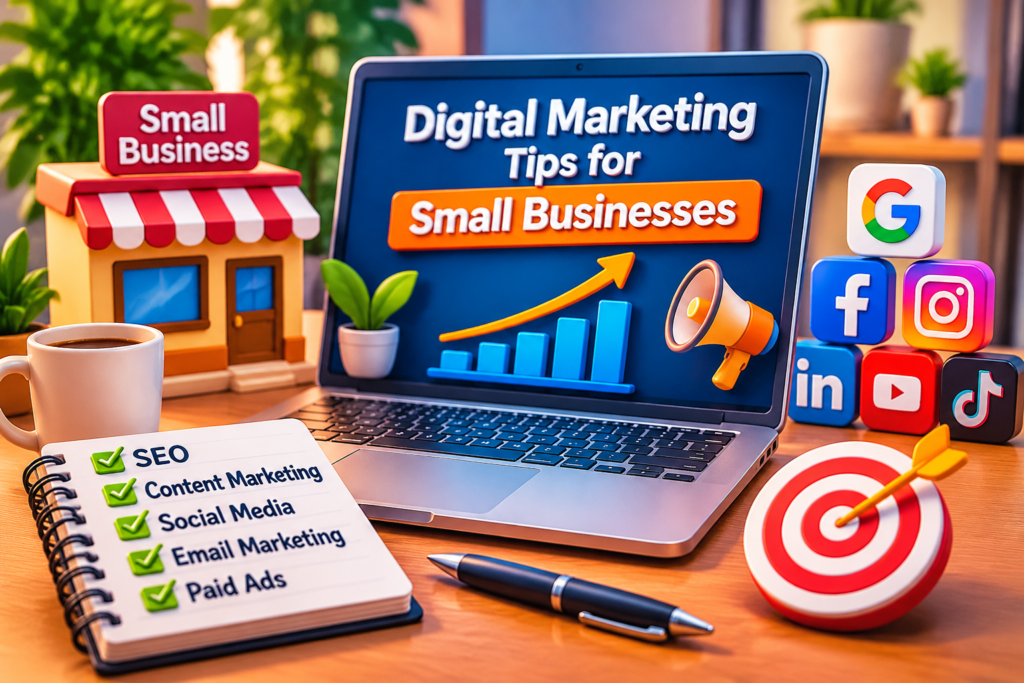
Following proven digital marketing tips for small businesses can help improve search visibility and attract customers who are actively looking for your services.
Running a small business is challenging, especially when you are competing against established brands with larger marketing budgets. Reaching new customers, building brand awareness, and generating consistent sales require more than simply posting on social media or running occasional advertisements. You need a digital marketing strategy that connects your business with the right audience and encourages people to take action.
The good news is that effective online marketing does not always require a significant investment. Small businesses can use search engine optimisation (SEO), content marketing, social media, email campaigns, and affordable digital tools to attract potential customers. The key is choosing strategies that match your audience, business goals, and available resources.
These digital marketing tips for small businesses can help owners attract qualified customers, improve online visibility, and build a stronger digital presence.
Whether you operate a local service company, an online store, or a growing startup, these digital marketing tips for small businesses will help you establish a stronger online presence, reach more potential customers, and build sustainable business growth.
Understanding Digital Marketing for Small Businesses
Digital marketing involves promoting products and services through online channels such as search engines, websites, social media platforms, email, and digital advertising. Unlike traditional marketing, many digital channels allow businesses to measure engagement, understand customer behaviour, and adjust campaigns based on performance.
For small businesses, this creates opportunities to compete more effectively without spending heavily on television advertisements, billboards, or large promotional campaigns. A local business can attract nearby customers through Google Search, while an online retailer can reach shoppers through content, social media, and targeted advertising.
Successful marketing starts with understanding what customers need and how they search for solutions. Instead of trying every available platform, focus on channels that help your business reach its intended audience.
Define Your Target Audience
Before investing time or money in marketing, identify the people most likely to purchase your products or services. Understanding your target audience helps you create relevant messages, choose appropriate marketing platforms, and avoid spending resources on people who are unlikely to become customers.
Small businesses can apply these digital marketing tips for small businesses to attract new customers and improve their online visibility.
Start by examining your existing customers. Consider their age ranges, locations, interests, purchasing habits, common challenges, and reasons for choosing your business. Customer feedback, website analytics, sales records, and social media interactions can provide useful insights.
You should also research competitors serving similar audiences. Look at their products, messaging, customer reviews, and promotional strategies to identify opportunities your business could address.
For example, a small accounting firm might target independent contractors and local business owners who need affordable bookkeeping support. Its marketing content could focus on organising financial records, preparing for tax season, and managing business expenses.
The US Small Business Administration provides useful resources for market research and competitive analysis.
Build a Professional, Mobile-Friendly Website
Implementing digital marketing tips for small businesses consistently can help improve customer engagement and support long-term growth.
Your website is often the first place potential customers visit after discovering your business online. It should clearly explain what you offer, who you serve, and how visitors can contact you or make a purchase.
A professional website does not need complicated animations or expensive design features. It needs a clear layout, useful information, fast loading times, and straightforward navigation. Make sure your homepage communicates your main value proposition without forcing visitors to search through multiple pages.
Mobile optimisation is particularly important because many customers browse websites using smartphones. Check that text remains readable, buttons are easy to tap, images display correctly, and contact forms work on smaller screens.
Include essential pages such as:
- Home page explaining your main products or services.
- About page introducing your business and its experience.
- Products or services page describing your offerings.
- Contact page with accurate business information.
- Blog or resource section providing helpful information.
- Privacy policy explaining relevant data practices.
Add clear calls to action throughout your website. Depending on your business, these might encourage visitors to request a quote, schedule an appointment, subscribe to updates, or purchase a product.
Improve Your Website with Search Engine Optimisation
Search engine optimisation helps search engines understand your website and helps potential customers discover relevant pages through organic search results. It is one of the most valuable long-term digital marketing strategies for businesses that want to attract visitors without paying for every click.
Begin with keyword research. Identify the phrases your potential customers use when searching for your products, services, and solutions. Tools such as Semrush can help you evaluate search volume, keyword difficulty, search intent, and related search terms.
For example, a local cleaning company might target phrases such as “residential cleaning services,” “affordable house cleaning,” and “professional office cleaning.”
Use relevant keywords naturally in page titles, headings, introductory paragraphs, image descriptions, and URLs. Avoid repeating the same phrase unnecessarily, as keyword stuffing can make content difficult to read.
Other important SEO practices include:
- Writing original and useful website content.
- Creating descriptive page titles and meta descriptions.
- Improving website navigation and internal linking.
- Optimising images with descriptive file names and alt text.
- Fixing broken links and technical errors.
- Ensuring important pages can be crawled and indexed.
- Earning relevant backlinks through valuable resources and industry relationships.
Use Google Search Console to monitor search impressions, clicks, queries, indexing information, and average positions. Google Analytics can provide additional information about website visitors and their interactions.
For further guidance, consult Google’s SEO Starter Guide.
Create Helpful Content That Attracts Customers
Content marketing allows small businesses to demonstrate their knowledge, answer customer questions, and build trust before asking people to purchase anything.
Rather than publishing promotional messages repeatedly, create resources that help your audience solve genuine problems. Useful content can include blog articles, tutorials, product comparisons, checklists, videos, case studies, and frequently asked questions.
For example, a small landscaping company could publish articles about seasonal garden maintenance, choosing suitable plants, preparing lawns for winter, and improving outdoor spaces. These resources can attract people searching for practical advice while introducing them to the company’s services.
Develop a simple content calendar to maintain consistency. You might publish one detailed blog article each week, share two or three social media updates, and create one short video based on an existing article.
Each piece of content should have a clear purpose. Some content can attract new visitors, while other resources can answer purchasing questions or encourage existing customers to return.
Focus on usefulness, accuracy, originality, and a clear understanding of your audience rather than producing articles simply to increase your publishing frequency.
Use Social Media Strategically
Social media gives small businesses an opportunity to connect with customers, showcase products, answer questions, and develop a recognisable brand identity.
However, maintaining an active presence on every platform can consume valuable time. Choose platforms based on where your intended customers spend their time and what type of content your business can produce consistently.
Instagram and Facebook can work well for visual products, local promotions, and customer engagement. LinkedIn may be more suitable for professional services, business consulting, and B2B companies. TikTok can help businesses introduce products through short, engaging videos.
Create a balanced content strategy that includes:
- Educational posts answering common customer questions.
- Product demonstrations showing how offerings work.
- Customer testimonials and genuine feedback.
- Behind-the-scenes updates introducing your business.
- Announcements about new products and special offers.
- Short videos explaining useful tips or solutions.
Respond to comments and messages professionally. Social media should encourage conversations rather than function as a one-way advertising channel.
Track engagement, profile visits, website clicks, enquiries, and conversions to understand which content contributes to your business goals.
Invest in Local SEO
Local SEO is particularly important for businesses that serve customers in specific cities, towns, or neighbourhoods. It helps your business become more visible when people search for nearby products and services.
Start by creating or updating your Google Business Profile. Provide accurate information about your business name, address, telephone number, website, operating hours, and services. Choose relevant business categories and upload genuine photographs that represent your products, premises, or work.
Encourage satisfied customers to leave honest reviews. Respond to feedback politely, including negative reviews, and address genuine concerns whenever possible.
Your website should also include useful local information. If you serve multiple locations, consider creating dedicated pages that explain your services in each area rather than publishing repetitive pages with only city names changed.
Maintain consistent business information across relevant online directories and professional listings.
According to Google’s local ranking guidance, local results are primarily influenced by relevance, distance, and prominence. Complete business information and genuine customer reviews can help customers understand and evaluate your business.
Build an Email Marketing Strategy
Email marketing provides a direct way to communicate with customers without depending entirely on social media algorithms or paid advertising.
Start building an email list through your website, checkout process, appointment forms, or newsletter subscriptions. Explain what subscribers will receive and obtain appropriate permission before sending promotional messages.
Instead of sending identical offers to everyone, organise subscribers into relevant groups. For example, an online store might separate first-time customers, repeat purchasers, and people interested in particular product categories.
Create email campaigns that provide useful information and encourage meaningful engagement. Welcome messages, product announcements, educational newsletters, seasonal offers, and abandoned-cart reminders can all support different stages of the customer journey.
Keep your emails clear and readable. Use descriptive subject lines, concise messages, and a single primary call to action where possible.
Monitor open rates, click-through rates, unsubscribes, and conversions to evaluate campaign performance. Also follow applicable email marketing requirements, including the US CAN-SPAM Act.
Use AI Tools to Save Time
Artificial intelligence tools can help small businesses manage routine marketing tasks, generate ideas, organise information, and improve productivity. They can be particularly useful when a small team has limited time and resources.
For example, generative AI tools can help brainstorm blog topics, prepare social media content outlines, summarise customer feedback, and develop initial email drafts. AI-powered design and video tools can also assist with creating promotional materials.
However, AI-generated content should always be reviewed before publication. Check factual claims, verify statistics, correct misleading information, and ensure the final material reflects your business’s knowledge and experience.
You can also explore AI applications for customer support, appointment management, and lead organisation. Choose tools that solve specific problems rather than adopting technology simply because it is popular.
If you want to understand the technology further, explore our guide on how to learn artificial intelligence for beginners.
Try Affordable Paid Advertising
Organic marketing can take time to generate results. Paid advertising can provide additional visibility when you need to reach a specific audience, promote a new product, or generate enquiries.
Google Ads allows businesses to target people searching for relevant products and services. Social media advertising can introduce your offerings to users based on selected audience characteristics and interests.
Before launching a campaign, establish a clear objective. Decide whether you want website visits, telephone enquiries, product purchases, or appointment bookings.
Start with a manageable budget that your business can afford to test. Create focused advertisements, use relevant landing pages, and monitor performance regularly.
For example, a local plumbing company might run a small Google Ads campaign targeting people searching for emergency plumbing services in its service area. It could then measure telephone enquiries and booked appointments to determine whether the campaign is worthwhile.
Avoid increasing advertising expenditure simply because an advertisement receives clicks. Focus on meaningful outcomes, including qualified leads, sales, and customer acquisition costs.
Encourage Customer Reviews and Testimonials
Customer feedback can influence purchasing decisions, particularly when potential buyers are comparing unfamiliar businesses.
Encourage customers to share honest experiences after completing a purchase or receiving a service. You can send a polite follow-up email, provide a review link, or ask for feedback through an appropriate customer communication channel.
Display genuine testimonials on relevant website pages, such as service descriptions and product pages. Include specific details when customers have given permission to share them.
Do not purchase fake reviews, offer misleading incentives, or pressure customers into providing positive ratings. Authentic feedback is more valuable for building long-term credibility.
Respond to reviews professionally and use recurring feedback to identify areas where your products, services, or customer experience could improve.
Track Your Marketing Performance
Digital marketing becomes more effective when you understand which activities generate useful results. Measuring performance helps you identify successful campaigns, recognise problems, and make better decisions about where to invest your resources.
Start by selecting a small number of key performance indicators that match your business objectives.
| Marketing metric | What it helps measure |
|---|---|
| Organic traffic | Visitors arriving through unpaid search results |
| Search impressions | How frequently pages appear in search results |
| Click-through rate | Percentage of impressions resulting in clicks |
| Conversion rate | Percentage of visitors completing a desired action |
| Cost per lead | Advertising expenditure required to generate a lead |
| Email click rate | How frequently subscribers click campaign links |
| Customer acquisition cost | Average cost of acquiring a customer |
Use Google Search Console to evaluate organic search performance and Google Analytics to understand website engagement and conversions.
Review your results regularly rather than making decisions based on a single day’s performance. Compare similar periods, consider seasonal changes, and identify which channels contribute to meaningful business outcomes.
Create a 30-Day Digital Marketing Action Plan
Knowing what to do is only part of the process. Small businesses also need a manageable schedule that turns marketing ideas into consistent activities.
The following 30-day plan provides a practical starting point.
Week One: Understand Your Audience and Website
- Identify your ideal customer and their main challenges.
- Review your website’s content, navigation, and mobile experience.
- Research relevant keywords using Semrush.
- Check your website’s search performance in Google Search Console.
- Set two or three measurable marketing goals.
Week Two: Improve Search Visibility and Content
- Update important website pages with relevant information.
- Improve page titles, headings, and meta descriptions.
- Publish one helpful, original blog article.
- Add relevant internal links between related pages.
- Review your Google Business Profile if your business serves local customers.
Week Three: Develop Customer Engagement
- Establish a consistent social media publishing schedule.
- Create educational posts and short product demonstrations.
- Start building an email subscriber list.
- Encourage genuine customer reviews.
- Respond to customer questions and messages.
Week Four: Measure and Improve
- Review website traffic and search impressions.
- Identify which content receives the most engagement.
- Evaluate enquiries, leads, and sales.
- Review advertising performance if you ran paid campaigns.
- Identify improvements for the following month.
This schedule is flexible. Adjust it according to your available resources, business type, and marketing priorities.
Common Digital Marketing Mistakes to Avoid
Even a well-planned marketing strategy can struggle when businesses make avoidable mistakes. Recognising these problems early can help you use your resources more effectively.
One common mistake is trying to maintain a presence on too many social media platforms. Spreading your attention across multiple channels can reduce content quality and consistency. Start with the platforms that matter most to your audience.
Another problem is publishing content without understanding search intent. An article may contain relevant keywords but still fail to answer the questions visitors actually have. Research customer needs before creating content.
Small businesses should also avoid ignoring website performance, publishing inaccurate information, buying backlinks, and relying entirely on paid advertising. These approaches can undermine long-term marketing results.
Most importantly, do not expect immediate success. SEO, brand awareness, customer relationships, and organic visibility develop over time. Regularly review your results and make improvements based on reliable data.
Final Thoughts
Growing a business online requires a clear strategy, consistent effort, and an understanding of customer needs. The most effective digital marketing tips for small businesses are not necessarily the most expensive or complicated. They are the approaches that help you reach the right audience, communicate your value, and turn interest into meaningful customer relationships.
Start with the fundamentals: understand your audience, improve your website, create helpful content, and establish a reliable search and social media presence. As your business develops, introduce email marketing, local SEO, AI tools, and paid advertising where they support your objectives.
You do not need to implement every strategy at once. Choose a few practical improvements, measure their results, and build on what works. With a consistent approach and informed decisions, your small business can develop a stronger online presence and create opportunities for sustainable growth.
Frequently Asked Questions
What are the best digital marketing tips for small businesses?
The most useful strategies include improving website SEO, publishing helpful content, using social media strategically, investing in local SEO, building an email list, and measuring marketing performance. The best combination depends on your audience and business goals.
How can a small business start digital marketing with a limited budget?
Start with affordable activities such as creating a professional website, setting up a Google Business Profile, publishing useful blog content, and maintaining social media accounts. Free resources such as Google Search Console can help you monitor performance.
Why is SEO important for small businesses?
SEO helps potential customers discover relevant website pages through organic search results. It can attract people who are actively looking for particular products, services, or solutions without requiring businesses to pay for every website visit.
How often should a small business publish marketing content?
There is no universal publishing schedule. A realistic starting point might include one useful blog article each week and several social media updates. Consistency, accuracy, and audience relevance are more important than publishing large quantities of content.
Which digital marketing tools should small businesses use?
Useful options include Semrush for keyword research, Google Search Console for search performance, Google Analytics for website analysis, Canva for visual content, and email marketing platforms for subscriber communication. Choose tools according to your actual requirements and budget.
How long does digital marketing take to produce results?
The timeline varies by channel, competition, website quality, and marketing investment. Paid advertising may generate visits quickly, while SEO and organic brand growth generally require ongoing work. Regular measurement helps businesses understand progress and improve their strategy.




[…] a small business involves much more than finding customers and making sales. Business owners must manage enquiries, maintain customer records, follow up with […]